SAP S/4HANA Migration: Key Benefits for Manufacturing Companies
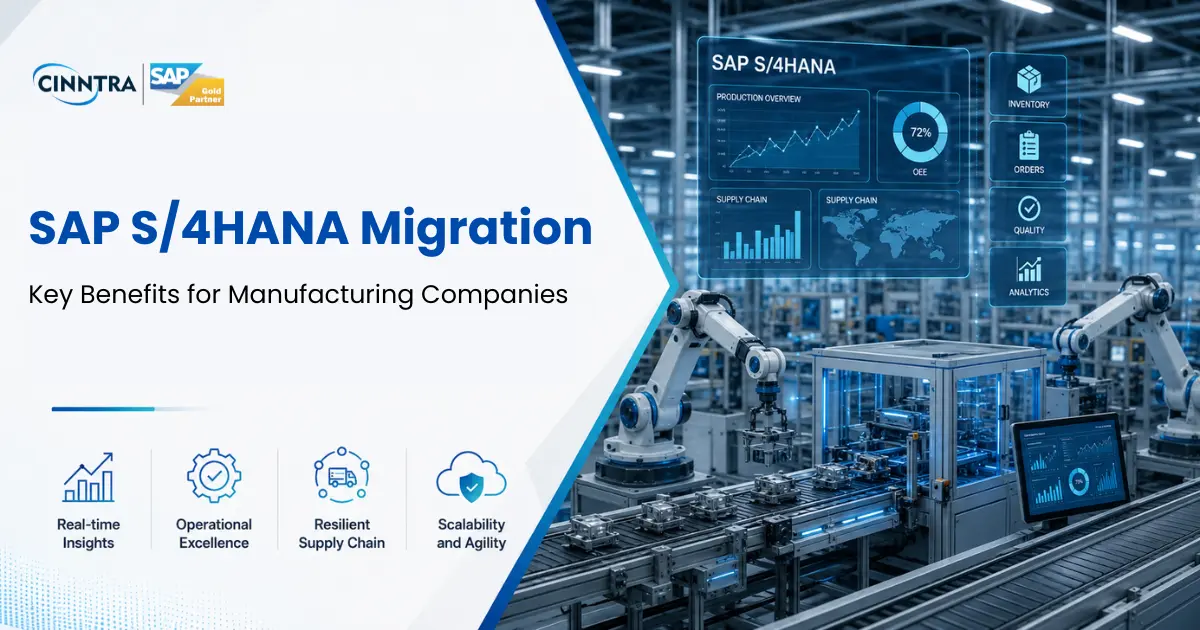
"Something went wrong, and we only find out two days later." This is how an operations manager at a medium-sized auto parts manufacturing company had once described working on SAP ECC. It's not a process issue. It is an issue of the system itself, an issue that SAP S/4HANA Migration solves.
Why should Manufacturing Companies Migrate from SAP ECC to SAP S/4HANA?
Manufacturing is a game of time. An hour's delay at the factory can set back your whole delivery by days. You may not notice the lack of a raw material supply on Tuesday, but come Friday, you could lose that customer due to the oversight. The manufacturing systems designed to handle these processes need to do so quickly, with precision, and in real time.
SAP ECC is an older system. Yes, it works fine. The only problem is it doesn't work well, or fast, nor is it easy to maintain.
What is the difference between SAP ECC and SAP S/4HANA?
But the biggest difference is not in the features. It is in the database.
SAP ECC works with traditional database technology which takes up a lot of time and energy to report in real-time. SAP S/4HANA for Manufacturing works with SAP's in-memory database technology called HANA. Processes that used to take hours now take seconds. Updates that would be available by the end of the day can be available instantly with S/4HANA.
Apart from being fast, S/4HANA has a simpler architecture compared to ECC, because the old software accumulated over years and years of data duplication. In other words, it had the same data saved in several places for reporting purposes. SAP S/4HANA removed almost all duplications. That's why it is faster, maintenance is easier, and it costs less over time.
Finally, there is the difference of the interface of both systems. S/4HANA has a modern-looking UI called SAP Fiori, which is based on a web browser and looks great on any screen. ECC has an interface design from the year 2003. Shop floor supervisors and purchasing people who work with the system daily know its importance very well.
What Happens If Manufacturing Companies Don't Migrate Before 2027?
SAP discontinues mainstream support for ECC in 2027. Beyond that, updates become less frequent; updates to adhere to changing regulations no longer happen automatically, and it becomes more difficult to find consultants willing to work with your legacy system, with costs increasing accordingly.
From an industry perspective, this is more than a technical issue. Manufacturers who switch from SAP ECC to SAP S/4HANA for manufacturing have the benefit of using technology that is built on AI and machine learning capabilities. Manufacturers using ECC come out of support by 2027 will have to operate a technology that is obsolete.
What are the Key Benefits of SAP S/4HANA for Manufacturing Companies?
Real-Time Production Visibility
ECC allows the production manager who checks the status of the work orders to view information which is updated up to the last batch processing time, perhaps several hours ago. In S/4HANA, however, the manager can access real-time data where failure of equipment by 10:00 AM will affect productivity, as shown by 10:01AM.
Faster and More Accurate Planning
SAP S/4HANA for Manufacturing provides fast MRP (Material Requirements Planning), way faster than ECC. The job that used to take one night to process is now done in just minutes, enabling scenario planning and adjustments within a single day.
Lower Inventory Costs
Since the manufacturing companies have access to real-time inventory information and have faster MRP runs, they keep less buffer inventory, simply because they believe in their information. In one example, an equipment manufacturing company reduced its safety stock level by 18 percent within its first year of migration.
Better Financial Visibility
In ECC, there are separate systems for production and finance data, which sync up according to a predefined schedule. However, in S/4HANA, each transaction related to production orders, movement of materials, and labor costs is entered into the accounting ledger immediately.
What Advanced Functionalities do Manufacturers get after SAP S/4HANA Migration?
In addition to the enhancements, SAP S/4HANA upgrade offers features which are not available in ECC.
Embedded Analytics: This includes live dashboards for managers in ERP software. There is no need for any separate reporting software and data export since everything is seen in one dashboard.
Predictive MRP: The S/4HANA system utilizes machine learning to predict any possible shortages of supply in advance based on the analysis of supplier lead times, current inventory levels, and demand trends.
Digital Manufacturing Integration: S/4HANA seamlessly connects with IoT sensors, shop-floor execution applications, and machine data from third-party sources to create the basis for smart factories.
What are the Approaches to SAP S/4HANA Migration for Manufacturing Companies?
Three options are available, depending on the complexity of your system and your readiness for transformation.
Greenfield: Adopt S/4HANA afresh while transferring data, removing all previous configurations and customizations. Perfect for businesses looking to start fresh after many years of patchwork systems.
Brownfield: Upgrade your ECC environment into S/4HANA without changing anything else. More efficient and less disruptive than other methods. Retains history and configuration data, even legacy baggage.
Selective Data Transition (Hybrid): Build an entirely new S/4HANA system, while selectively transferring only the relevant data processes. Best method for flexibility, preferred by manufacturers who have multiple plant sites using ECC.
The selection of the right method for you is not merely a technical question. It depends on your process weaknesses, data quality, and ability to undergo organizational change. The selection of a proper manufacturing partner for SAP S/4HANA is crucial, not only for implementation but also for usage in production.
What are the Key Steps in an SAP S/4HANA implementation for manufacturers?
1. Assessment and Planning - Analyze the ECC implementation, perform quality checks on data and SAP Readiness Check. Based on the findings, establish goals and determine the method for migration. This is the starting point of everything.
2. Design & Build - Map business processes for S/4HANA workflows, cleanse data, and configure. Data quality is important. It is often the primary bottleneck and can be easily overlooked.
3. Test & Train - Test end to end within manufacturing, purchasing, stock management, and finance. Changes will have impacts everywhere. Train production managers and planners ahead of go-live.
4. Go-Live & Hypercare - The first 90 days after launch make or break you. Problems will arise, users will have to deal with new situations, and edge cases will be uncovered. A committed support presence in these critical months makes the difference.
Remember the plant manager who was notified about those problems after two days? With SAP S/4HANA, that alert comes through on time before the problem even gets to affect shipping or phone calls. Manufacturing companies that make that move in the right way will never have to react anymore.






0 Comments