Agentic AI in ERP: How Cinntra Is Enabling Autonomous Business Processes and Intelligent Operations
A finance team’s usual way of closing their books includes pulling reports manually, chasing down approvals, and fixing the mismatches by hand. On top of this, they have to wait a few days for the numbers to be verified. People think agentic AI is built to help these teams close books faster but in fact it is built to close books for them.
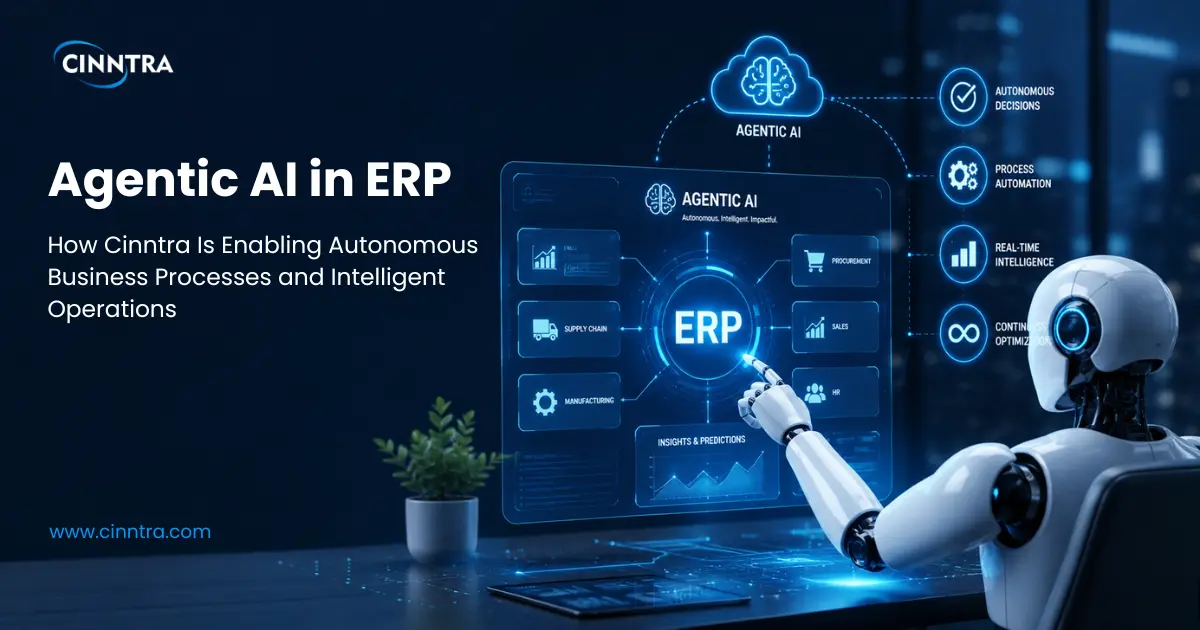
Agentic AI in ERP are those AI agents which don’t recommend actions inside an ERP environment but take those actions on their own.
For example, agentic AI does not flag a low inventory level which needs to be reviewed by someone, but checks supplier pricing, generates a purchase order and sends it for approval according to existing rules, all on its own.
2025 was already being called the year in which businesses started using agentic AI in practice because of the difference between deciding and doing.
What Is Agentic AI in ERP, and How Is It Different from Automation?
Agentic AI in ERP are independent agents that plan, decide, and can carry out various business tasks inside your ERP system with minimal human intervention. These agents are not at all similar to a chatbot or copilot, that only answer a question and stop. An agent is given a specific goal, and it performs all steps which are required to get there whether it is pulling data, checking policy, or calling the right system. It escalated to a human only when there is some exception.
According to Gartner, agentic AI is among the top strategic technology trends all the way to 2028.
How Is Agentic AI Different from RPA And Older ERP Automation?
ERP automation in older systems only performed tasks it was programmed to do. This ability was useful, but it was also inflexible.
For example, an invoice matching bot will compare a purchase order with the receipt and if the numbers are the same, it approves. If not, it stops and hands over this exception to a human.
Agentic AI works in a different manner. It can understand the situation, adjust when things change, and make a series of decisions without needing a person to rewrite new rules in every scenario. The system becomes the one where work actually gets done instead of just being a system that records.
What Is an Agentic AI Workflow and How Does It Work in Real Business Processes?
Let’s take the example of a medium-sized distributor who notices a low inventory level of a specific SKU on a Tuesday. In the older system, a human used to spot this low inventory alert manually, checked two or three supplier quotes, and issued a purchase order after almost two days (only if there was no other work on their desk).
In an agentic workflow, the agent detects a low inventory level itself when it falls below a specific level, compares the supplier prices and lead times, creates a purchase order, and then sends it for approval. The human’s job changes from doing this task himself to reviewing only when there is an exception that the agent cannot resolve.
What Agentic AI Capabilities Exist in SAP Today, and How Is Cinntra Helping Businesses Use Them?
What AI Capabilities Does SAP Business One Offer?
AI capabilities in SAP Business One uses natural language to interact with your data. It can also automatically extract documents and has workflows driven by agents for sales and finance functions. This means that a business can ask questions in plain English to get a report or even let an agent keep check of incoming orders and generate the sales document automatically.
At the S/4HANA and enterprise level, AI in SAP runs with the help of Joule Agents. It consists of more than 40 agents and 2400+ skills built inside S/4HANA, Ariba, SuccessFactors, and IBP.
For example, SAP’s Autonomous Close Assistant is an agent that reduces the time taken to close books (from weeks to days) by taking care of journal entries, reconciliation, and error resolution directly.
How Does Cinntra Help Businesses Adopt and Govern Agentic AI In SAP?
Cinntra SAP consulting services concentrate on the parts which most vendors miss – getting agentic AI set up inside a client’s actual business environment correctly. This process includes identifying which two or three agents deliver real ROI for a specific business. Cash management, dispute resolution, and supplier risk generally are the common starting points.
Cinntra Agentic AI solutions work with CIRA, which is Cinntra’s own natural language querying software on top of SAP. CIRA allows a user to ask questions about the data in plain language while the decision-making part is handled by agents like Joule. This distinction is important because an agent that answers questions is not the same as the one that closes your books.
This work happens through staff augmentation. Cinntra consultants sit inside the client’s SAP environment with the internal IT team, set up agent permissions and test workflows before anything runs unsupervised.
Is Agentic AI Ready for Mid-sized Businesses, Or Only Large Enterprises?
Medium sized businesses can adopt agentic AI selectively, not for complete replacement of their existing workflows. The businesses which are seeing results are not the ones which deploy every available agent on day one. They are the ones which pick narrow, high-friction processes, such as purchase order generation or invoice reconciliation. Every action taken by an agent needs to be traceable back to what it did, the reason why it did it, and what data was used. This traceability will ensure that the CFO approves of the agent running unsupervised.
The finance teams that still close the books manually are not stuck there because the software doesn’t exist. They are stuck because they haven’t connected the agent to the right data or the right rules or the right escalation path yet. Agentic AI does not eliminate the need for that foundation work. It just makes the financial close an automatic process instead of the one that used to take three days by hand.






0 Comments