SAP S/4HANA for Automotive Industry: Processes, Benefits and Implementation Roadmap
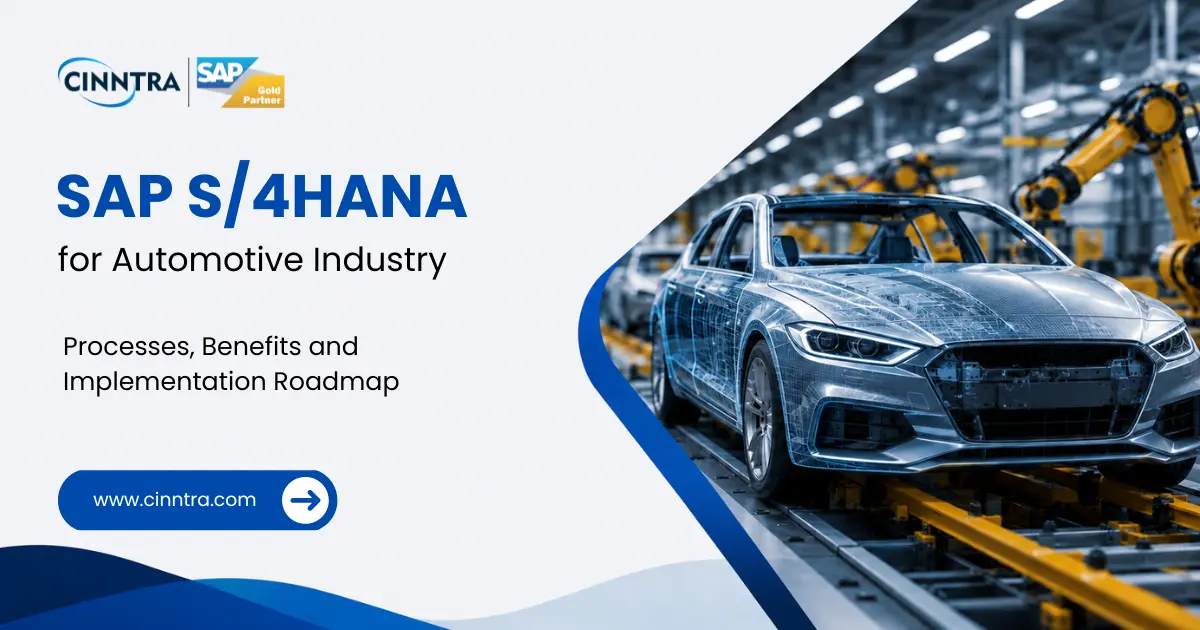
Just one assembly line is able to build twenty different variants back-to-back without stopping – different colors, different trims, different markets, different regulatory specifications – all on the same conveyor belt. Most of the older ERP systems are unable to tell the difference between variants twelve and thirteen until a wrong part is put on a car.
This gap between what is actually happening in the plant and what the system thinks is happening is the main problem that SAP S/4HANA for automotive industry operations was made to bridge.
Automakers, Tier-1 suppliers, and dealers operate on a very thin margin and tight sequencing. If a Just-In-Sequence is missed, it does not just delay one order, but it can stop an entire production line which costs thousands of dollars to sit idle for even a minute. This is why SAP for automotive industry implementations are completely different from a standard finance and logistics rollout. The system is required to understand things like build sequences, part variants, and supplier call-offs in real-time and not overnight.
What Processes Does ERP for Automotive Industry Operations Actually Automate?
SAP S/4HANA automates the processes which can potentially go broken as volume and complexity increase. These processes can include sequencing, traceability, and supplier coordination.
How Does SAP S/4HANA Support Just-In-Time and Just-In-Sequence Manufacturing?
SAP S/4HANA matches the incoming supplier deliveries exactly to the build sequence that is on line in real time. Traditional ERP systems, which are batch processed, update inventory and production data on a delay – sometimes overnight. SAP S/4HANA, that runs on the in-memory HANA database, updates as soon as a part is scanned or a schedule changes. This means that the JIS and JIT call-offs to suppliers show the actual line 7sequence instead of the plan from yesterday.
How Does Traceability Work for Recalls and Quality Compliance?
From raw material to the finished vehicles – every component gets tracked so that any defect can be traced all the way back to its production lot, supplier, and affected vehicles within hours rather than weeks. This factor is important for IATF 16949 quality compliance and also for scoping a recall before it goes from three vehicles to three thousand. The availability of batch and serial traceability in SAP S/4HANA is what enables this speed.
What Financial and Supply Chain Processes Change with SAP S/4HANA?
Finance, procurement, and production planning go from existing on separate systems which sync at the end of the month to existing on a single system reflecting the same numbers in real-time.
|
Process |
Legacy ERP approach |
SAP S/4HANA approach |
|
Supplier call-offs |
Batch file exchange, updated daily |
Real-time EDI, updated per scan |
|
Production sequencing |
Manually adjusted against MRP output |
System-driven, matched to line sequence |
|
Recall traceability |
Manual cross-referencing across systems |
Automated batch/serial lookup, hours not weeks |
|
Financial close |
5–7 days, manual reconciliation |
2–3 days, integrated postings |
|
Carbon/material tracking |
Spreadsheet-based, retrospective |
Built into production data, ongoing |
Benefits are seen in the form of numbers. According to SAP performance benchmarking, automotive companies which use S/4HANA to track allocation and status of machinery in real time see:
-
A reduction in manufacturing costs by 15% where the equipment usage is tracked continuously instead of auditing it periodically
-
A reduction in cost per customer interaction by 13% when the service and sales channels are present in one system
-
Faster financial close cycles, going from a week to 2-3 days
-
Revenue that is measurable from circular economy processes – reused and recycled components generate much more revenue per unit over a vehicle’s lifetime than a single sale
None of these benefits are a result of the software alone. These benefits come from processes which used to be handled in spreadsheets or add-on tools and now exist in a single system which runs both production and finance.
How to Implement SAP S/4HANA for Automotive Industry Companies: A Step-by-Step Approach
The implementation strategy decides how much of the existing SAP landscape is worth keeping.
-
Assessing the current landscape – Mapping the existing ERP systems, custom objects, and workflows specific to the automotive industry such as JIT/JIS logic, EDI connections, quality processes before deciding on an implementation approach.
-
Choosing greenfield, brownfield, or hybrid - Greenfield creates new processes from the start and is suitable for companies that have heavily customized or outdated ECC systems. Brownfield migrates already existing data that is relevant and useful. Hybrid combines both of these approaches, sometimes at 20-40% lower project cost than a completely new build from scratch.
-
Configuring automotive industry-specific modules – This includes production planning, EWM and warehouse integration, and quality management as per IATF 16949.
-
Integrating with MES, CRM, and supplier EDI – The ERP is as fast as the systems that feed data to it. Connecting shop-floor MES and supplier networks makes sequencing in real-time possible.
-
Testing, training, and go live in phases – The effectiveness of the ERP is tested on one plant or product line first before the full rollout along with unit, integration, and user acceptance testing at every stage.
-
Running hypercare and monitoring KPIs – Sequencing errors and gaps in data start to occur in the weeks after the go-live. A dedicated support post go-live helps in preventing small issues from becoming huge problems that lead to a line shutting down.
Most automotive implementations of large scale take 9 to 18 months depending on the scope. The data quality work in the design phase helps in preventing delays more than any other step.
The assembly line that makes twenty different variants works only if the system underneath it knows exactly which variant is going to come down the belt next. SAP S/4HANA for automotive industry operations bridges exactly this gap. Instead of adding more dashboards, it makes sequencing, traceability, and supplier data update in real time rather than after it has already happened. The manufacturers who get this process correct are the ones who run the line in the way it was initially planned.






0 Comments