NetSuite and AI: How to Move from Automation to Autonomous Operations
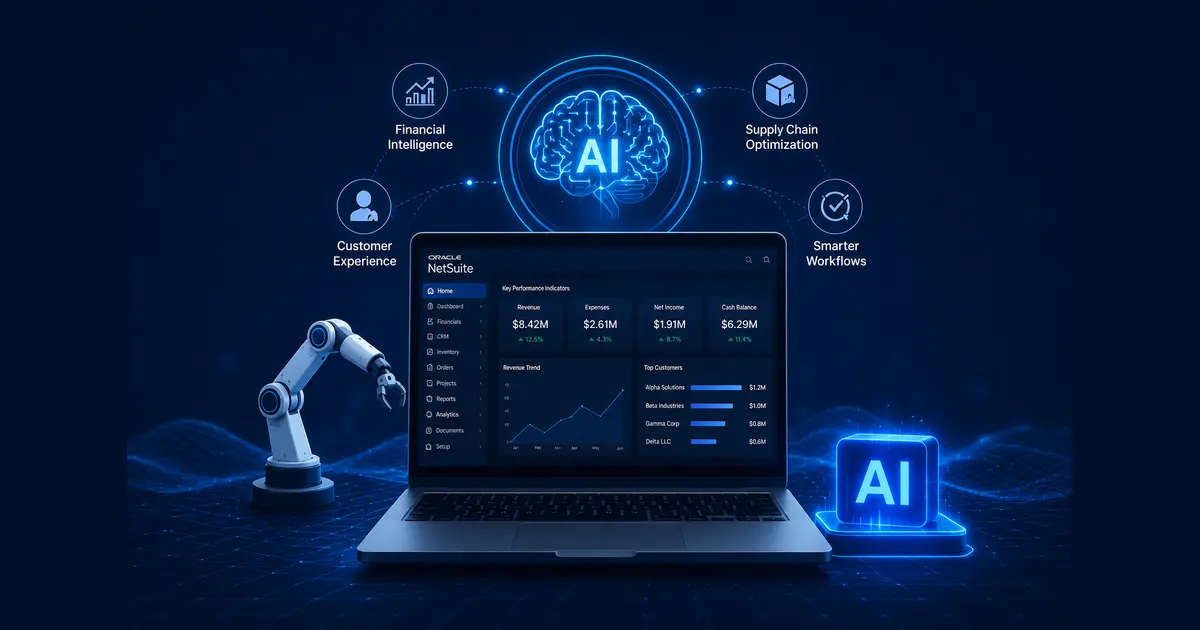
Your NetSuite dashboard flags a stockout. A person still has to see the alert, decide what to reorder, and enter the purchase order. That gap between the system knowing something and the system acting on it is the entire difference between automation and autonomy, and it's where most conversations about AI in NetSuite get confused.
Businesses often use "automated" and "autonomous" as if they mean the same thing when they talk about AI in NetSuite. They don't, and the difference decides what your team can actually stop doing manually.
What Is the Difference Between AI Automation and Autonomous Operations in NetSuite?
AI in NetSuite falls into two categories, and most implementations today still sit in the first one.
What Does Automation Actually Do Inside NetSuite?
Automation in NetSuite follows rules a person already wrote. A workflow triggers when an invoice hits a certain amount. A saved search flags overdue receivables. Accounts payable automation matches a PO to a bill and routes it for approval. The system executes exactly what it was configured to do, every time, and nothing outside that configuration.
This is where most NetSuite customers are today, and it already removes a lot of manual work - matching, routing, and reminding. What it doesn't do is decide. A person still reviews the exception, approves the deviation, and handles anything the rule didn't anticipate.
What Changes When NetSuite AI Becomes Autonomous?
Autonomous operations remove that review step for defined, bounded tasks. The system doesn't just flag an anomaly - it investigates it, proposes a resolution, and in some cases acts on it within set permissions. Oracle's own Autonomous Close feature, part of the NetSuite Next rollout, is built on exactly this idea: reconciliations that used to take a finance team days now get handled by an AI agent that reconciles accounts, flags what it can't resolve, and proposes journal entries for a human to sign off on.
| Aspect | Automation | Autonomous Operations |
|---|---|---|
| Trigger | Fixed rule or schedule | Business goal or exception |
| Decision-making | None – follows pre-set logic | System evaluates options and picks one |
| Human role | Reviews every exception | Reviews outcomes, not every step |
| NetSuite example | AP automation, saved search alerts | Autonomous Close, agentic workflows |
The distinction matters for budgeting, too. A pure automation project has a fixed scope: you're paying to remove a specific manual task. An autonomous operations project is closer to hiring - you're defining a goal and a set of guardrails, and the system works within them.
How Is NetSuite Moving from Automation to Autonomous Operations?
Oracle has been explicit about this shift since SuiteWorld 2025, and the 2026 roadmap gives a clearer picture of what AI in NetSuite looks like once it stops being a bolt-on and becomes part of how an AI cloud ERP runs day to day.
What Is NetSuite Next and How Does It Enable AI Cloud ERP?
NetSuite Next is Oracle's rebuilt version of the platform, and it's the delivery vehicle for most of what people mean by AI in NetSuite going forward. It bundles three pieces that matter here: Ask Oracle, a natural-language assistant for querying data without building a saved search first; AI Canvas, a planning workspace where a user can adjust a variable like pricing or volume and see the downstream effect across financial and operational metrics immediately; and the AI Connector Service, which uses the Model Context Protocol to let external AI tools (including large language models) read and act on NetSuite data under defined governance rules.
The NetSuite 2026.1 release builds on this by embedding AI agents directly into EPM workflows for reconciliation, forecasting, and cost allocation, rather than treating AI as a separate reporting layer.
Is Agentic AI in NetSuite Actually Autonomous Yet?
Mostly not, and that's a useful thing to know before you plan a budget around it. Current agentic workflows in NetSuite operate best inside well-defined processes with clear rules and measurable outcomes. They still depend heavily on data quality and require governance frameworks around them, not fewer controls. Oracle has not confirmed general availability dates for the more ambitious agentic capabilities across all regions, and industry estimates put full production readiness for deep autonomous workflows at twelve to twenty-four months out for most accounts.
That doesn't make the current AI in NetSuite features cosmetic. Bill capture with OCR, anomaly detection on unusual vendor activity, and narrative reporting that explains a variance without a person writing the summary are functioning today, not on a roadmap slide.
What Should Businesses Do to Prepare for Autonomous NetSuite Operations?
The businesses getting real value aren't the ones with the most AI features turned on - they're the ones sequencing the rollout instead of switching everything on at once:
-
Audit before you automate further. Know which AI features are already active in your edition and region before layering in more.
-
Fix data quality first. Every source on agentic AI in NetSuite comes back to the same point: poor data produces poor decisions, autonomous or not.
-
Start with one bounded workflow. Month-end reconciliation or AP matching are safer starting points than customer-facing processes, because the rules are already well-defined.
-
Keep a human in the approval loop for anything outside the pattern the system was trained to recognize, at least for the first several cycles.
None of this requires ripping out your current setup. An AI cloud ERP rollout works in layers on top of the NetSuite instance you already run, not as a replacement for it.
That stockout alert from the opening doesn't have to wait for someone to notice it between meetings. With the AI Connector Service and agentic workflows Oracle is rolling out through NetSuite Next, the system that spots the gap and the system that closes it are starting to become the same system. The question for most businesses right now isn't whether to get there, but which process to hand over first.






0 Comments