

RPA in Healthcare
Smarter Automation for Faster, Safer Care Delivery

An intelligent framework for automating processes in the health service industry to reduce redundancies, simplify operations, and enhance health outcomes.

Schedule a Free Consultation
RPA in Healthcare
What is RPA in Healthcare

What is RPA in Healthcare?

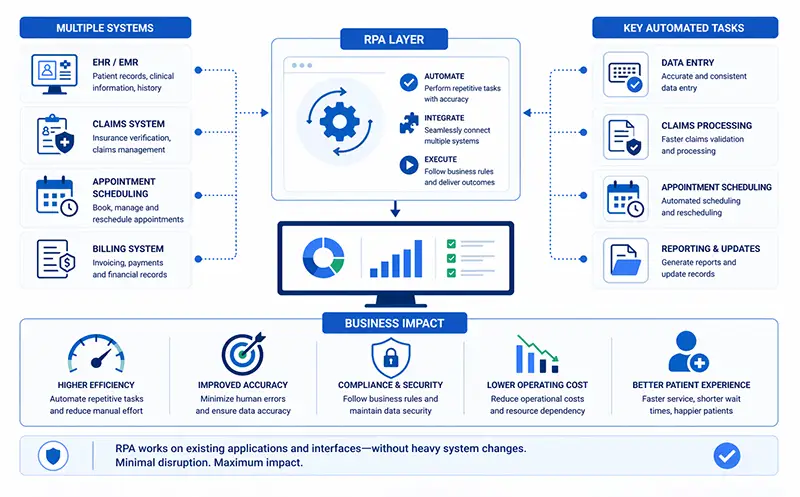
RPA in the Healthcare industry is defined as deploying software bots on existing physical and/or virtual user interfaces to perform defined tasks across multiple systems, with the following specific business rules. RPA performs tasks through automated actions such as data entry, claims processing, and appointment scheduling.

Unlike complicated AI systems, RPA performs actions on existing applications and application components, and does not require a significant level of change to the existing application or technology infrastructure, resulting in less investment in technology modification. In addition, RPA operates 24/7, consistently produces the same result each time it is executed, and, when employed by healthcare providers, improves operational efficiency by minimizing errors.

Engineered for Precision & Speed

Built for Modern Healthcare Operations

RPA is a technology that enables businesses to automate the processing of high-volume rule-based processes quickly and accurately. When an organization's operations have been streamlined and all the necessary standard operating procedures and controls have been implemented, there will no longer be bottlenecks in the organization, and all workflows will be executed consistently. After implementing RPA, healthcare professionals can devote more time to providing patient-centric care instead of spending valuable time performing repetitive tasks.

RPA can be integrated into the existing systems of an organization, such as electronic health records (EHR) and billing systems, and all organizations can benefit from their ability to provide real-time visibility into their operations without requiring any disruption to an organization's existing technological architecture. By automating administrative tasks, healthcare organizations can improve customer service while maintaining regulatory compliance.

Reduce Administrative Workload Across All Departments
Increase Process Speed Through Consistent Execution
Increase Visibility Across Workflows
Enable Enhanced Interoperability in all Systems

Healthcare Automation

Advanced Healthcare RPA Solutions

Healthcare Automation streamlines repetitive processes that slow down an organization's operations. Current functionality in the healthcare industry will continue to have an impact on an organization's response to patients as well as on the quality of service provided to patients. Automation allows staff members to complete more tasks per hour as well.

Automation in the Healthcare Industry

Using automation can assist organizations in meeting the growing demand for services while simultaneously utilizing limited resources in the healthcare sector. By standardizing workflow processes within each department of an organization, automation creates a consistent means of performing work within an organization.

Robotic Process Automation in Healthcare

RPA is the use of bots to accomplish tasks quickly and accurately, e.g., handling claims, updating patient information, and completing reporting functions. By implementing RPA, organizations can reduce delays and improve accuracy.

HIPAA Compliance Automation

Using HIPAA compliance automation allows for secure processing of patient personal information (PHI) through controlled workflow processes, which allow organizations to have audit-ready processes while minimizing their compliance risk to fulfill regulatory requirements.

Automation in healthcare systems

The use of automation within the healthcare system connects multiple platforms into one integrated workflow, allowing for seamless exchange of data between EHR systems and billing tools/tokenization of third-party applications. Automation breaks down data silos and allows for the continuation of care.

Our Healthcare Automation Capabilities

Implementation

We continuously evaluate existing workflows and identify opportunities to automate them, then work collaboratively with your organization to design a solution to meet operational goals.

Managed Services

By monitoring and optimizing your organization's automation workflows continuously, we can improve the efficacy of those workflows and maintain a consistent level of performance over time.

Process Optimization

Optimizing existing workflows allows organizations to streamline their processes by removing inefficiencies and providing greater clarity with respect to how work gets done.

System Integration

We integrate automation into your existing healthcare system workflows (EHR, billing, etc.) to ensure no interruption in operations and seamless data flow.

Custom Bot Development

We develop custom bots based on your unique and specific workflow requirements. All bots are designed to meet compliance and operational needs.

Key Applications of Automation in Healthcare

Patient Operations

Provides automated onboarding channels, appointment scheduling, and patient records updates so patients can receive better service from their healthcare providers while also being able to reduce patient waiting time.

Claims Processing

Provides claim verification to speed up the insurance process for patients, thus increasing revenue cycle efficiency and reducing revenue cycle delays.

Billing Processes

Increases billing accuracy by allowing billers to use automated tools that will reduce the number of manual adjustments required to receive payment for healthcare services.

Data Management

Automates the management of healthcare data across multiple providers in order to increase the accuracy of healthcare data and eliminate duplicate healthcare issues.

Compliance & Reporting

Automates audit trails and the management of regulatory compliance audits. This provides healthcare organizations with a mechanism to monitor compliance and demonstrate regulatory compliance to their customers.

Benefits of RPA in Healthcare

RPA in Healthcare provides measurable operational efficiencies and patient service improvements by reducing the amount of manual effort required and by improving the overall efficiency of operations. Healthcare organizations achieve quicker turnarounds (outcomes) with fewer error rates.

Healthcare organizations experience improved process consistency and more effective resource allocation as a result of RPA's inherent capabilities. Automation enables companies to operate continuously with no interruptions. Automation of processes improves compliance and data security for healthcare companies.

Decrease operating costs and manual efforts within the organization
Improve the accuracy of critical processes
Improve patient outcomes through quicker delivery of service
Enable 24/7 execution of workflows
Provide stronger compliance and data security

Drive Healthcare Excellence with Intelligent Automation

We provide automation solutions that are aligned with the contemporary needs of healthcare organizations and the operational demands and goals of their internal operations.

150+ Automation Specialists
100+ Processes Automated
60+ Workflows Optimized
10+ Years Industry Experience

Request a Consultation

Discover how automation can transform your healthcare operations.

Flexible Deployment Model

Reduction in operating costs due to the efficiency created by the implementation of automation.

Provides an environment for securing sensitive healthcare data from unauthorized access by using automated processes.

Quickly deploys automation into the organization's operations with minimum disruption.

As an organization grows, the organization can quickly add additional automation capabilities to meet operational demands.

Seamlessly integrate automated processes into the existing systems of the organization.

Continuously optimize automation capabilities.

Frequently Asked Questions

What differentiates healthcare RPA from AI?
RPA will automate any rule-based function, and AI will take care of all the complex decisions and unstructured data.
How much does it cost to implement RPA in healthcare?
The cost varies depending on how complex the process is and how many locations to implement it at. Most RPA in healthcare starts small, then accelerates growth based on return on investment in the company's bottom line.
Can Cinntra develop customized RPA solutions for healthcare?
Yes, Cinntra creates customized RPA solutions that work with your specific workflows and requirements for compliance.
Will RPA integrate with my current systems?
RPA in healthcare will connect to EHRs and will connect to billing systems and legacy applications without having to make large-scale changes.
Is patient data secure when using automation?
Yes, using HIPAA compliance in automation will keep secure handling of patient data whenever there is audit trails created or controlled access provided to anyone.
Can Cinntra provide automation at an enterprise-wide level?
Cinntra develops RPA in healthcare that is scalable so that as departments grow and new locations are established, expanded growth happens seamlessly across the entire organization.
Let’s Start a Conversation

Partner now with the tech catalysts to transform your ideas into leading impact.