SAP Business One vs Microsoft Dynamics 365 Business Central: Which ERP Is Best for SMEs
A distribution company selects an ERP in just 6 weeks based solely on one demo. After eighteen months, they were paying a third-party consultant to add on the supply chain module which the sales rep did not mention at all in the beginning.
This is the usual way in which most SMEs end up choosing between SAP Business One and Microsoft Dynamics 365, and it's also why this decision deserves to focus on more than just a features list.
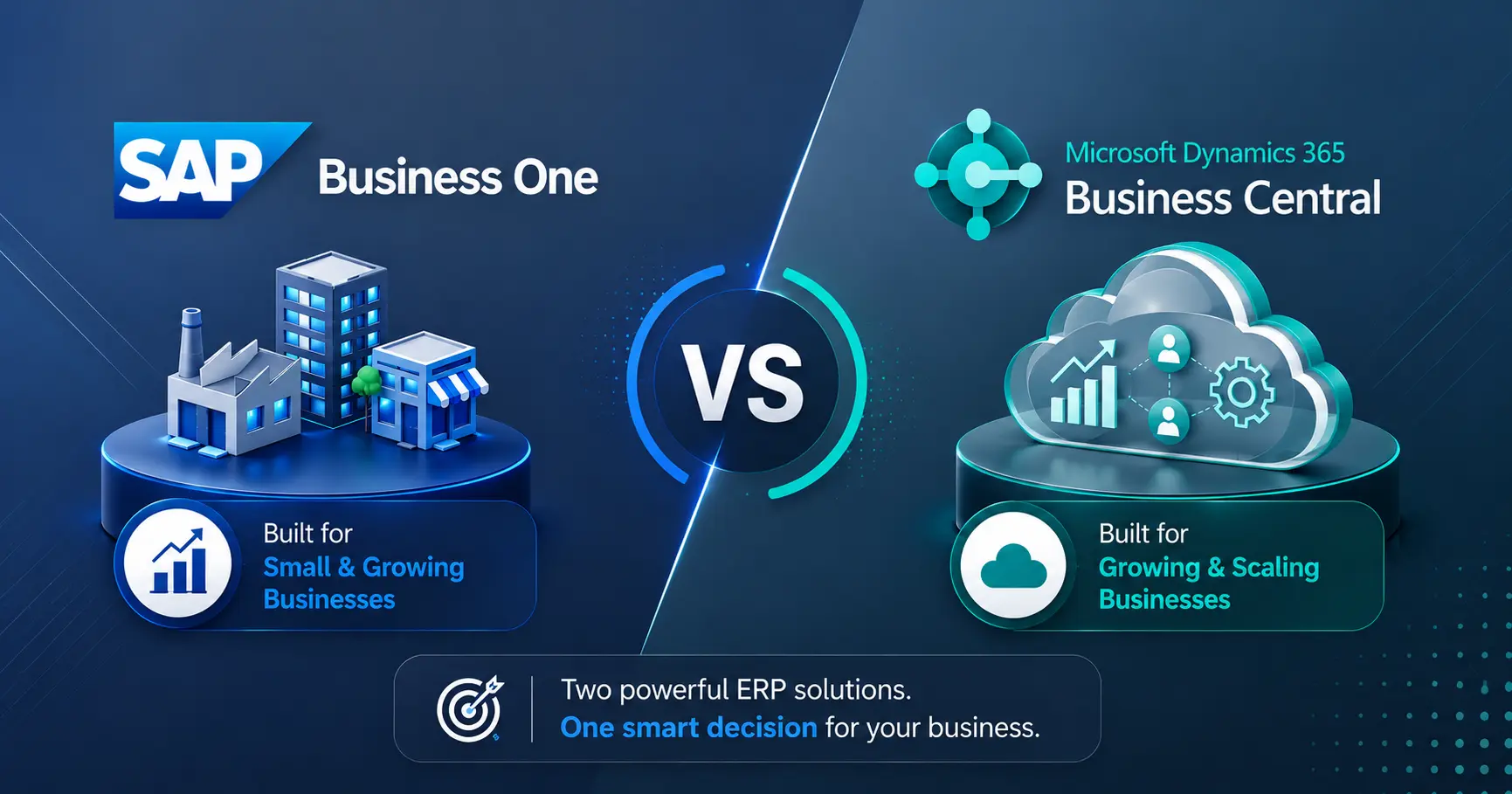
SAP Business One is best suited for SMEs with complicated manufacturing, distribution, or compliance needs that want a single integrated system. On the other hand, Microsoft Dynamics 365 Business Central is suitable for those SMEs that are already running on Microsoft 365 and want a cloud-based platform with an option to add Power Platform and Copilot later. Neither of the two options is “better” because the right option depends on what the business is currently running on and what its plans are for scaling.
What Is the Difference Between SAP Business One and Microsoft Dynamics 365?
The main difference between the two is how each is built – the architecture and not just the features.
SAP Business One is a single and integrated ERP software. All functions like finance, purchasing, inventory, sales, and CRM work together inside a single environment from day one. A company that has 60 employees and runs a light manufacturing business can go live easily with most of what it needs already present in the base product.
Microsoft Dynamics 365 Business Central works more like a platform than a single tool. It is a finance and operations layer built inside a broader Microsoft environment which includes Teams, Power BI, Power Platform, Outlook. A business which is already running on Microsoft 365 faces a smooth handoff between the ERP and everyday tools because there is a familiar ecosystem there already.
How Do They Compare on Deployment?
SAP Business One provides cloud deployment, on-premise deployment, and a combination of these two (hybrid deployment). This is important for SMEs with data residency requirements or SMEs that have unstable connectivity in the manufacturing plant.
Business Central is cloud-first and runs on Microsoft Azure. This means that the security patches and updates are automatic, but the company cannot opt for the on-premise option that SAP B1 customers mostly use.
How Do They Compare Cost?
| Factor | SAP Business One | Microsoft Dynamics 365 Business Central |
|---|---|---|
| Starting license cost | From roughly $94–95/user/month | From roughly $70/user/month |
| Deployment options | Cloud, on-premise, hybrid | Cloud only |
| Base functionality | Finance, inventory, CRM, purchasing integrated from day one | Finance and operations core, extended via AppSource add-ons |
| Manufacturing depth | Strong in base; supply chain add-ons cost extra | Requires Premium license for manufacturing |
| Microsoft 365 integration | Available via connectors | Native (Outlook, Excel, Teams, Power BI) |
| Implementation timeline | Often quicker for straightforward finance/inventory setups | More structured rollout, built for long-term scaling |
| Best fit | Manufacturing, distribution, regulated industries | Microsoft-ecosystem businesses, service and project-based firms |
The price actually is in favor of Business Central, but a manufacturer who needs SAP B1’s supply chain module, or a Business Central customer who requires a Premium license for production planning, will be able to see the gap become smaller or reverse. SAP vs Microsoft ERP cost comparison is an important discussion only when the specific modules the business needs are priced out and not just the entry-level basic license.
Which One Has Better Reporting?
The reporting tools in SAP Business One work well when the company needs basic financial and operational reports without any heavy customization. Business Central’s main advantage is the presence of Power BI and Excel integration. This means that the finance team already builds reports in Excel and can extend the same without the need to learn a completely new interface.
Which ERP Should a Growing SME Actually Choose?
The answer to this question depends majorly on three things: what the business is running on today, how complicated the operations are, and where it wants to be in the next three years.
Is SAP Business One Better for Manufacturers and Distributors?
Yes, in most cases. SAP Business One ERP was built keeping in mind that finance, inventory, and operations should work together natively. This is shown very clearly with the help of:
-
Multi-warehouse inventory, which gives visibility to a distributor tracking stock in several locations without having to add a separate module
-
Bill of materials and production orders that lets manufacturers get core production planning built into the base system
-
Fewer third-party add-ons for basic supply chain visibility which means there would be less integration work to see what is happening on the floor
Is Microsoft Dynamics 365 Better for Microsoft-Ecosystem Businesses?
Yes, but only if the company is already using Microsoft 365 for email, documents, and collaboration. Microsoft Dynamics 365 Business Central has the following strengths:
-
There is less difficulty switching between disconnected systems because the ERP is present inside the same environment as Outlook, Excel, and Teams
-
A service company or a project-based company is able to automate approvals and dashboard without the need to hire developers because of Copilot and Power Platform
-
The interface is familiar for existing Microsoft 365 users so there is shorter ramp-up time for staff that is already using the tools on a daily basis
SAP Business One vs. Microsoft Dynamics 365: Which ERP Is Right for Your Business?
The suitability depends on the type of business:
-
An engineering company which bills on a project-basis and works on Outlook will be a better fit for Business Central
-
A distribution company that manages lot tracking and multiple warehouses will get more value from SAP B1’s integrated operations
Neither of these is “wrong” for the other system because they are just optimized for different operating models
What Should an SME Actually Do Before Deciding?
Before deciding, companies should understand and specify what modules they will need in the next 24 months and not just today. This is because supply chain add-ons, manufacturing depth, or Microsoft 365 dependency will definitely change the real cost and the real fit. Companies should get quotes for those modules specifically, not just the entry-level license. Apart from this, talk to a partner who implements both of these, because the vendor who sells just one system has no reason to point out where it will not be suitable.
That distributor who selected an ERP in six weeks and paid for it again eighteen months later did not choose the wrong system because they did not compare the features well. They chose it because they never thought to ask what their operations would look like after two years. The SMEs that do this well treat the ERP decision as a three-year long impact and not just a six-week purchase. This is the difference between an ERP that grows with the business and one the business quietly grows out of.






0 Comments