AI-Powered ERP for CFOs: How Finance Teams Are Closing Faster and Planning Smarter
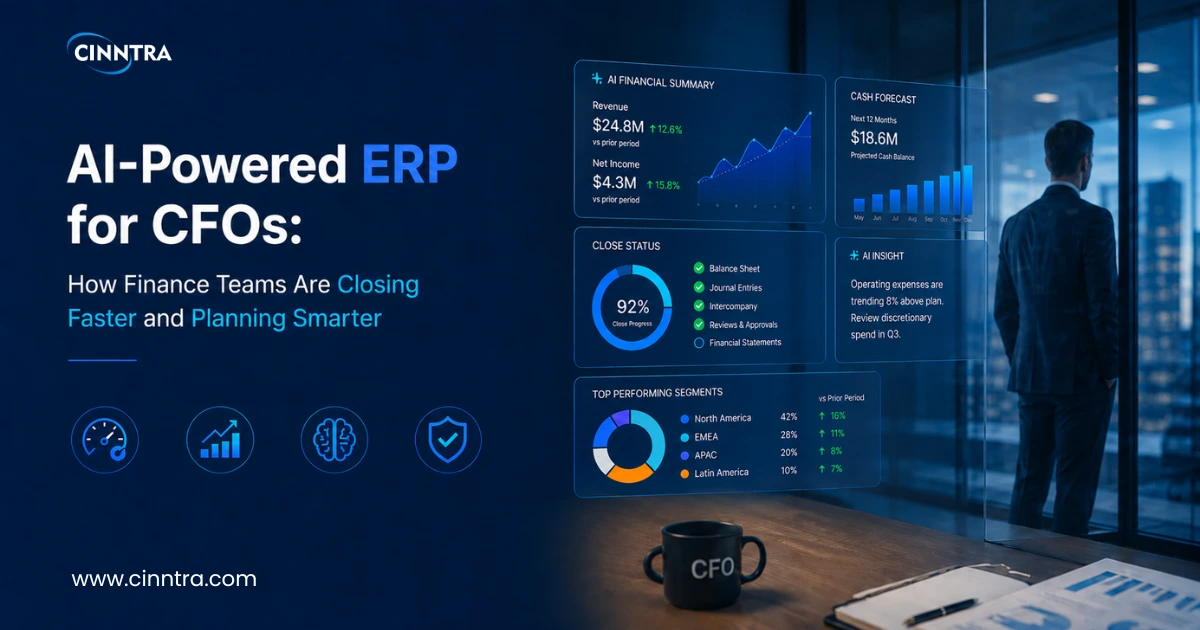
What happens when your CFO wants to know why the G&A expense is 15% higher than what was forecasted? The data is all there in SAP but to retrieve it, you would need to raise a request with the IT team and wait for a scheduled report or send it to an analyst who will then spend hours on it to get final output needed by you.
Even though the data exists, the real problem is how you would be able to access it.
AI-powered ERP for CFOs will help you solve that problem. It will not change your ERP environment but will make it answerable.
How Can CFOs Get Faster Financial Insights from ERP Data?
In medium and large enterprises, finance teams lose a significant amount of time in extracting numbers because that requires them to have certain technical skills which they usually do not possess. Data such as the break-down of P&L by product category, cost-revenue analysis, or identifying which products are running at a loss all exist in the company’s ERP already. But in order to retrieve those numbers, you need SQL knowledge, IT or a BI team which usually already has a lot of requests.
In a 2024 Deloitte survey, it was found out that 73% of finance leaders spend more than half of their time on tasks that are of low to no strategic importance. A lot of that time is spent on waiting for reports or building them manually.
Finance automation software, which is built as an AI layer on top of ERP, solves this problem easily and two major platforms have the same thoughts on this idea using different paths.
What Can A CFO Ask An AI-powered SAP System?
The range of questions it can answer is wider than you can imagine. CIRA, which is Cinntra’s AI integration with SAP ERP, handles a number of queries such as:
-
Profit margin by product category which is retrieved in real-time and broken down by line
-
Cost versus revenue analysis for a defined period with variance highlighted automatically
-
Business units or products which are loss making without the need for a manual report
-
Any outstanding payments by customer with measures like average, median, range, etc.
-
Detection of trend across regions or product lines
When a finance user types his question in plain English, CIRA identifies the relevant tables, runs queries against real-time data, and returns with an answer with smart recommendations. No need for SQL, middleware or scheduled report at all.
What Does AI-powered Querying Look Like on NetSuite?
Oracle has its own version of this capability which is built directly into NetSuite. The Ask Oracle assistant in NetSuite lets finance users put queries in the system in plain English.
SuiteAnalytics Workbook adds to regular reporting by introducing AI-powered pivot tables and trend analysis. Users can simply ask about what is causing cash burn and get answers or get a spend breakdown department-wise.
Tools that are already built into NetSuite only handle reporting and basic pivoting. They do not handle predictive modeling or scenario planning. This gap is closing fast because of the NetSuite 2026.1 release which added a multivariate AI forecasting capability that explains what business metrics influence each forecast. This enables the finance teams to verify the model and not just simply trust it.
Does Natural Language Querying Work on Enterprise ERP Data?
The main concern of most finance leaders is accuracy. If the system misreads a query, it can give the wrong result, and nobody would be able to catch it until the board meeting.
Both of these platforms acknowledge this issue through structure and not trust. CIRA gives responses in the form of structured tables with supporting analytics, so that a user can check the output before acting. Other than this, there is a role-based access control that defines what data a user can pull in the first place. Both platforms address this through structure rather than trust.CIRA returns results in structured table views with supporting analytics, so a finance user can verify output before acting on it, and role-based access controls limit what each user can pull in the first place.
NetSuite focuses on making forecasts easy to understand. It explains why a number is predicted instead of just showing the result. In both scenarios, the AI is supposed to be reviewed and verified and not just trusted.
How Do AI-Powered ERP Tools Change Financial Planning and Decision-Making for CFOs?
The first problem is accessing the data, and the second is what happens after you have it.
Traditional ERP tells you what has happened but does not tell you why it has happened. It does not tell you why margins are getting narrower or what the P&L will look like next quarter if that keeps happening. AI ERP solutions for finance teams help bridge this gap.
How Can AI Speed Up Financial Close in SAP & NetSuite?
In SAP, Joule’s finance agents take care of the process automation part of financial close.
-
Accounting Accruals Agent automates those entries which used to require manual review.
-
Financial Closing Assistant takes care of posting, journal entry verification, resolving errors, and matching intercompany transactions.
CIRA works along with this layer. During the closing period, finance leaders can query the system in plain English instead of manually doing everything.
On NetSuite, a similar function was introduced in the 2026.1 release.
-
Intelligent Close Manager: Progress monitoring using AI that reduce friction caused by switching tasks
-
Account Reconciliation AI assistant: Auto-assigning of new accounts to preparers, applying formats and learning from previous closing cycles
-
AI-powered transaction matching: Improves rule-based matching with ML and gives each of the suggested matches a confidence score
-
GenAI flux analysis identifies changes in balance above a particular limit and automatically creates simple explanations for them
According to Gartner, AI in cloud ERP will result in approximately a 30% increase in financial closing speed by 2028. 62% of the cloud ERP spending will be done on AI-enabled solutions by 2027, as compared to 14% in 2024. The organizations which are making this change now are the ones who will be prepared before it becomes a basic necessity.
How Do ERP Partners in India Help Finance Teams Get Value from AI?
The problem in most of the AI ERP implementations is not the AI, but the readiness of data. Cost center structures, GL structures, and vendor master records should be clean before any AI layer can use them correctly. This means that an answer which is delivered slow after checks but is accurate is still better than an answer which is delivered quickly but is wrong.
A reliable implementation partner in India does the work in three stages:
-
Data Readiness Assessment: First clean and verify the master data before adding any AI layer
-
Contained Pilot: Then picking and working one important use case like P&L queries, outstanding balance, or cost-revenue analysis
-
Scaled Deployment: Is done after verifying and matching the pilot’s correctness with existing reports
A study was conducted of 500 companies which were using AI in AR processing. 82% saw an increase in productivity and almost all of them reduced their days sales outstanding. This study confirmed that clean and well-defined data gives answers quickly and accurately.
The CFO who was not able to get a straight answer about the G&A expenses before the board meeting did not have a technology problem. The data was present, in SAP or NetSuite, but what was missing was a system that could answer questions in plain English using real-time data.
AI-powered ERP for CFOs delivers a new way to talk to the system you already have.






0 Comments