SAP Business One for Manufacturing: Bridging the Gap Between Planning and Execution
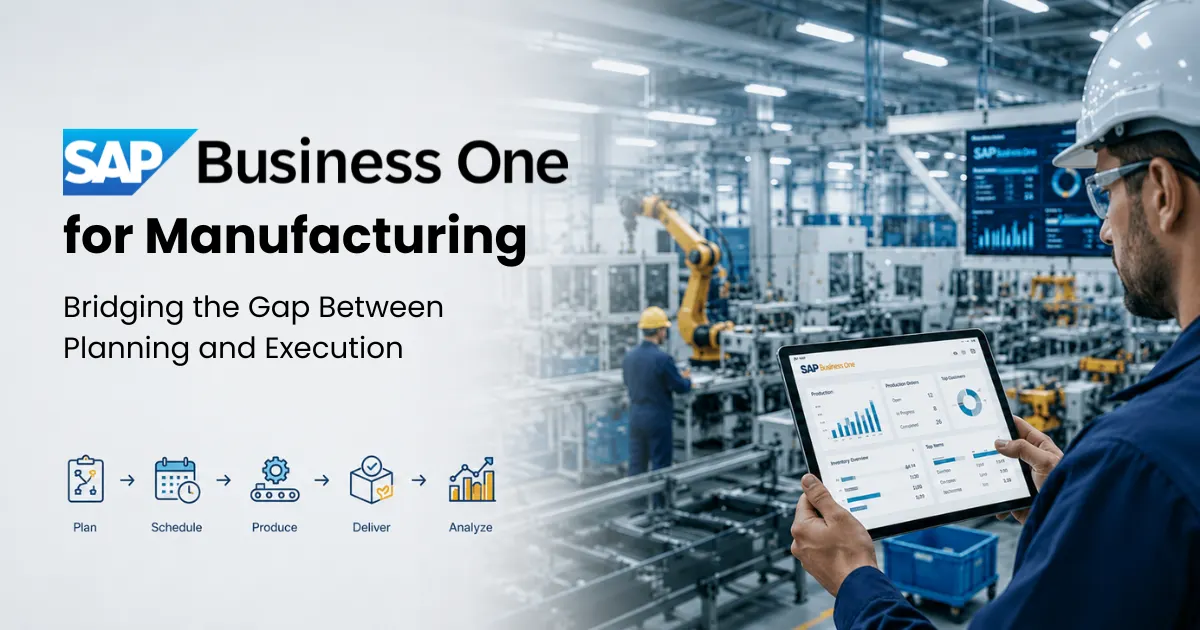
You need to deliver 500 units by Friday; however, the shop floor has quite another story to tell when the shift from spreadsheet to assembly line takes place.
Subpar product quality and lazy teams are not the causes of this silent killer of profitability in the manufacturing sector. The cause lies in the mismatch between planning and execution. Disconnected systems, manual updating of information, and wild guesses are not the right way anymore for manufacturers.
SAP Business One for Manufacturing was specifically built to bridge this gap.
What does SAP Business One do for Manufacturers?
What happens is that although many small and medium-scale manufacturers get their plans just right, the problem lies in linking those plans to the actual people and machines implementing them. This is because the scheduling is handled through one system by the production manager, whereas inventory handling takes place in a separate system, while shop floor operations still rely on a whiteboard. By the time data syncs, it's too late to take action.
This problem can be resolved with the use of SAP Business One manufacturing ERP. Purchasing, inventory management, production order, sales, and finance operations become unified in one live system.
For instance, whenever there is a new order coming in, the production planning automatically adjusts. Similarly, whenever there is a shortage in raw material inventory below a certain limit, the purchasing department automatically gets notified.
Why do Manufacturers Struggle Without a Unified ERP?
The issue here is delays in visibility. Where each set of data is stored differently and separately (production, procurement, and delivery), each decision is made on disorganized and late information. You cannot see across the checkpoints.
What would happen because of that blindness?
- If the demand requirement is not communicated to the factory in time, over/under production occurs.
- If purchasing does not know about the schedule, a shortage of raw materials takes place.
- If everybody sees the order delivery process differently, missed deadlines occur.
ERP for manufacturing that integrates all these processes has become a must-have tool nowadays. It would make you stand out from companies that solve an issue when it occurs, as a company preventing issues altogether.
How does SAP Business One Handle Production Planning?
Production planning on SAP Business One happens in a module named Manufacturing Resource Planning (MRP). This does one very important but simple thing. MRP considers the production needs, checks the quantity available in stock, and then gives you the exact quantity to purchase and the time at which to buy it.
But what do we mean by that?
- You place an order of 300 units of finished goods.
- SAP B1 will check the raw material available in your inventory.
- A Production Order with quantities, dates, and resource requirements will be automatically generated.
- There will be automatic alerts on items that need to be purchased.
- Inventory/Costing accounts will be automatically updated as soon as the production process starts.
No manual intervention is required. Data entry is immediate. There are no delays in checking and informing. The planning and execution of the plan remain in sync throughout.
How does SAP B1 Bridge the Gap Between the Floor and the Boardroom?
Planning vs. Execution is not just an operational problem but a financial one too. If the production and accounting data don’t match up, then it becomes impossible to determine the actual cost of manufacturing products. It will be too late by the end of the month to discover lost profits.
In contrast, the SAP Business One ERP for manufacturing allows integration of shop floor operations and financial management processes. The accounting ledger is instantly updated with information about production orders, materials, and labor costs. The CFO gets the actual cost per unit of production instantly.
What Specific Features Make SAP Business One a Strong Manufacturing ERP?
Apart from MRP, the other functionalities that come standard with the SAP Business One manufacturing ERP include:
-
Bill of Materials (BOM) Management: Specify the materials that go into a product. Multi-Level BOMs help manage products with multiple components. In case there is any change in the BOM, SAP will automatically update the cost and material requirements.
-
Production Orders & Work Instructions: You can create, issue, and monitor production orders in the system. Operators on the shop floor always receive updated work instructions rather than the old, printed manuals.
-
Capacity Planning: Know whether your machine and manpower can handle your planned production quantity before you commit yourself to the customer's delivery date. SAP B1 does this automatically to avoid over-promising.
-
Inventory Management and Tracing: Trace every raw material and finished product in the process of production with the help of SAP Business One. This will help ensure quality compliance.
-
Real-Time Dashboards: Receive real-time production, purchasing, and financial reports on time without wasting too much time.
Is SAP Business One the Right ERP for Small and Mid-Sized Manufacturers?
Businesses also think that SAP is suitable only for big enterprises. However, SAP Business One was especially designed for small and mid-size companies. They may purchase just those modules they need at first and add extra ones as their operation expands. The overall cost of ownership is substantially lower compared to SAP for big enterprises.
However, the quality of implementation is critical here. The SAP manufacturing process becomes effective only if done properly. Proper workflow analysis, configuration of the production structure, and good employee training become the distinctive features of the company compared to other companies using old-fashioned methods.
The gap between planning and execution is a systems issue, not a human one. A good ERP system eliminates this gap.






0 Comments