Why Traditional ERP Fails Growing Businesses and How SAP Business One Succeeds
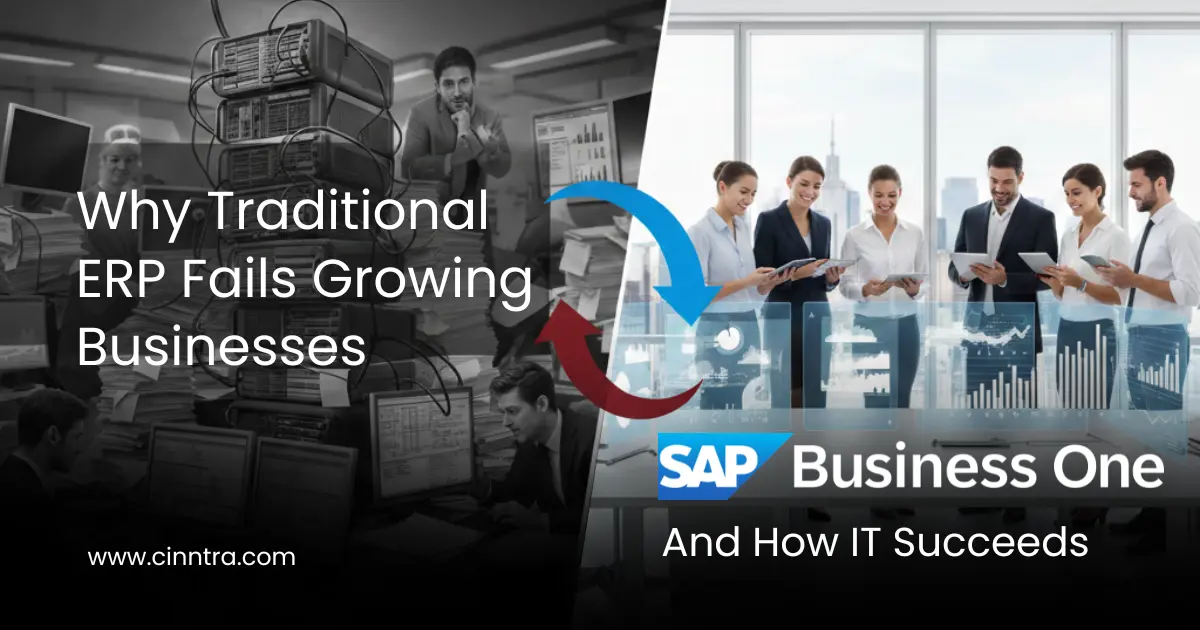
Running a growing business means moving fast and staying sharp. Leaders want systems that push growth forward, not slow things down. But too many companies still get stuck with clunky, old-school enterprise software. These traditional ERP systems just can’t keep up with the pace or complexity of scaling up.
If you’re looking for a solid ERP for your small or mid-sized company, you need something that adjusts the fly, gives you a clear view of what’s going on, and helps you grow without drama. That’s where SAP Business One really makes a difference.
What’s Wrong with Traditional ERP?
ERP systems initially emerged as comprehensive, high-end tools designed for large, established corporations with substantial resources and extensive IT teams. They pull everything, finance, inventory, operations, into one place. That sounds good, but is the reality? These systems are often way too rigid.
You usually need endless customization just to make them fit into your business. Projects drag on for months, even years. You need tech experts on call just to keep things running. For companies that want to move quickly, all this complexity becomes an anchor.
When smaller companies start comparing their options, they quickly see that old-school ERP can’t keep up with their growth.
Where Traditional ERP Falls Short?
-
Limited Scalability
When expanding into new markets, launching extra products, or seeing strong sales growth, traditional ERPs become stagnant. Changes, including customizations, usually take multiple iterations and get very expensive and can lead to system downtime. You’re then waiting to continue moving forward while systems work to get up to speed.
-
High Cost of Customization
To get a legacy ERP to operate in accordance with specific needs, customers tend to spend a lot of time and effort developing custom code. The more you tweak the ERP; the higher your ongoing maintenance bills and the more difficult and expensive future upgrades will become. The same situation applies to all mid-sized companies' profit margins.
-
Poor User Experience
If your employees don’t like using the ERP system for any reason, the ERP is essentially worthless. Many legacy ERPs feature complicated menus with a multitude of manual processes, creating excessive amounts of wasted time due to employees being forced to expend time merely becoming familiar with the systems instead of getting actual work done. In the end, efficiency tanks, and you don’t see the return you hoped for.
-
Slow Implementation
Long, drawn-out ERP installs can throw your business off balance. Growing companies can’t afford to be distracted from customers and sales for months on end. The longer it takes, the more you risk falling behind.
-
No Real-Time Insights
Today, you need up-to-the-minute data. Traditional ERPs make you wait for reports. If you’re guessing cash flow or inventory levels, you’re flying blind.
Why Modern ERP Matters?
Companies now expect their systems to be flexible and clear. SAP Business One meets these needs with a simple setup and smart automation. Instead of forcing you to bend to old technology, modern ERPs work with your business, not against it.
To grow their businesses, companies require connectivity and need to manage finance, sales, inventory, and everything in real-time. They also want (clear) dashboards that enable them to make bold decisions when necessary. Today’s very modern solutions, such as SAP Business One, allow companies to experience ERP transitioning from a behind-the-scenes tool to an engine of growth.
How can SAP Business One enable you to grow?
SAP Business One was developed to accommodate ambitious companies that need structure but don’t want a headache. It contains everything needed in an easy-to-manage system.
-
Scalable Architecture
You can continue to scale by adding users, starting new locations, and expanding existing locations without having to “rip apart” the original ERP system. With SAP Business One, you can add new modules or integrations as needed, so your original investment continues to provide you with value.
-
Cost Efficiency
Budgets matter, especially when you’re scaling. SAP Business One gives you big-league features at a price that fits mid-sized companies. Since you don’t need a ton of customization or upgrades, you spend less time in the long run.
-
Intuitive Interface
If the system is easy to use, your team actually uses it. SAP Business One is designed with simplicity in mind, using clearly defined drop-down menus and dashboards that are specific to each user's job function. Therefore, employees can get what they need quickly and be more productive.
-
Rapid Deployment
In today’s competitive world, speed is critical to business success; therefore, SAP Business One has been specifically designed to be deployed as quickly as possible by utilizing proven methodologies and thereby decreasing startup times. The customer will begin to see a benefit from the solution very quickly and will continue to be able to operate their business without interruption during implementation.
-
Timely Data Insights
The speed with which data can be accessed can make or break an organization. With SAP Business One for SMEs, businesses have access to interactive dashboards and automated reports that provide an up-to-the-minute view of their business. This allows executives to identify trends, react to risk, and seize new opportunities when they occur.
Key Capabilities That Drive Performance
SAP Business One offers organizations an integrated view of their bottom line through the following key features:
-
Financial Management – comprehensive accounting features that manage an organization's entire finance department from tracking the company’s total income and expenses, to paying and managing suppliers.
-
Inventory and Warehouse Management – integrated tools to control raw materials, finished goods, and the cost of goods sold.
-
Sales Management and Customer Management – tracking customers through all phases of sales, managing order fulfilment, and processing payments.
-
Procurement Management – tools to manage supplier relationships and supply chain management to ensure product availability.
-
Production and Resource Planning – tools to manage production, including raw materials consumed in production, finished goods produced, and sold by the business.
-
Mobile App – allows executives to see all their business information and status at their fingertips.
When everyone is using the same source of data to run their organization, it eliminates wasted time searching for information in multiple systems, minimizes errors, and fosters accountability throughout the organization.
If you’re running a small or midsize business, you need an ERP that keeps everything together. Instead of fighting with scattered tools, you get one platform that brings your operations and strategy into sync.
Empowering Growth with Modern ERP
Traditional ERP solutions can feel constrained, expensive, slow, and highly inflexible when compared to modern technology. As businesses grow, they require products that are aligned with their ambition and can assist in increasing speed. Therefore, many businesses are looking at modern ERP solutions that more accurately reflect the way they conduct business than legacy ERP products. SAP Business One stands out for being scalable, easy to use, and surprisingly affordable, all in one package.
When you roll out SAP Business One, you get real-time control over your operations, so you can manage growth without losing your grip. Companies using SAP Business One for SMEs set themselves up for steady, confident growth even when the competition heats up.
And honestly, having the right partner makes it so much easier. Cinntra helps growing companies put the right ERP strategy in place, making sure everything fits, works, and delivers real results. Having the right system, along with good leadership and guidance, will allow you to grow your business and enable you to succeed based on sound planning.






0 Comments