RPA for Healthcare: Automating Patient Data and Billing Processes
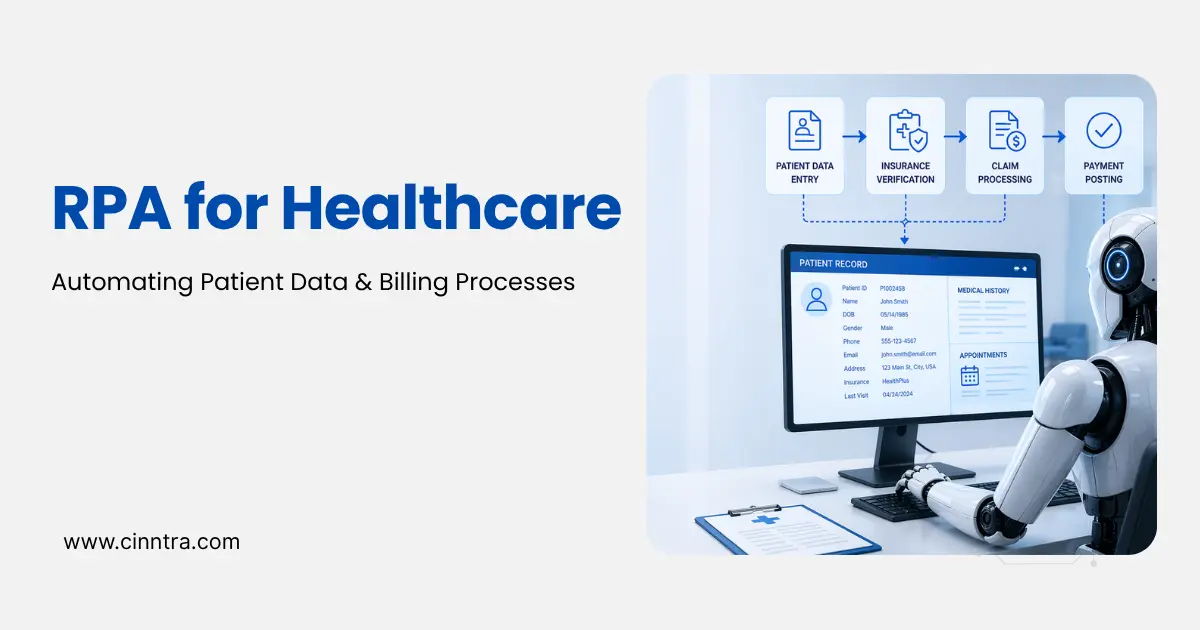
In today’s world of healthcare, there are not enough analytical tools available, and the data movements present many challenges. Data migration and validation take significant time and resources to move, leading to delays, inconsistencies, errors, and frustration with administrative staff (nurses, billing, case managers).
Robotic process automation (RPA) is one solution to those challenges. RPA does not replace legacy systems but adds a layer of automation to existing systems, doing repetitive tasks with a high level of speed and accuracy. RPA in healthcare systems improves the management of information and revenue streams.
What is RPA in Healthcare?
RPA in healthcare consists of software bots that perform structured, rule-based tasks on behalf of human beings. For example, bots can log into an application, fill in data, transfer data between applications, etc, but they will do so without error, without breaks, and will never stop working until the task has been completed.
RPA is very simple in concept. It does not require a complete overhaul of your systems but instead works within the existing environment. RPA improves your current processes and will not require reengineering your processes.
The Cost of Manual Workflows
Despite the advances made in technology, there is still a great deal of repetitive work being performed by healthcare staff. For example, on a daily basis, healthcare staff members will spend countless hours updating medical records, validating eligibility with payers, and ensuring that claims have been processed correctly.
As a result of these procedures, you experience a significant amount of friction in your operations. Fragmentation of data, lengthening of the billing cycle, and rising operational costs have all been the result of these processes. However, the biggest problem has been that all the time you could have spent providing care to your patients has been redirected towards performing administrative functions.
This is precisely how RPA delivers value to the healthcare industry by reducing friction and adding complexity to processes.
Bringing Order to Patient Data
Having consistent patient records is important not just from an operational point of view but also from a medical perspective; however, hospitals often record data manually, which can result in duplicate records or misinformation between different systems.
Healthcare RPA solutions solve this problem by ensuring that data flows freely between all contact points within the system. Whether it's during patient registration or recording changes to the patient's file, when automated, the accuracy of patient data can be maintained without ongoing human intervention.
The effect of this is both subtle and quite impactful. Patient information will be accurate, accessible, and used in decision-making with greater confidence.
A More Efficient Approach to Billing
Few things in the healthcare industry are as complicated or fraught with error as billing. Even the smallest error in the amount billed can delay payments or result in a claim rejection.
RPA for Healthcare applies a more disciplined approach to the bill-paying process. Automated processes verify patient insurance, validate the claim submitted to the payer, and provide necessary follow-up with an acceptable degree of precision. Many automated processes can occur with little or no human intervention when compared to traditional processes that require much human oversight.
Because of this, the result is not only faster billing, but the revenue cycle is much more reliable than it has been because there are fewer, if any, interruptions and greater clarity surrounding the finances.
Operational Gains That Extend Beyond Efficiency
The benefits of automation tend to be discussed in terms of speed improvements and cost savings. And while these two factors are important benefits, they also represent only a portion of what needs to be considered as far as the total benefits of using this type of technology.
With RPA for Healthcare, organizations begin to reorganize human resources. The administrative load that is imposed by traditional processes is greatly reduced so that skilled professionals can perform their job functions. Workflows have become less erratic; as such, errors that were once commonplace are now infrequent.
In this sense, while automation will not eliminate the need for human input, it will enhance it.
Integration Without Disruption
Healthcare RPA solutions are unique in their ability to integrate with existing systems; they do not require any changes to an organization’s current systems. In fact, RPA solutions act as enhancers of current processes, helping to fill in areas where integration has not been achieved.
Identifying tasks that an organization performs regularly is typically the first step in implementing RPA solutions. From there, a bot can be programmed to perform these tasks without requiring any input from the end user. Therefore, the transition to utilizing RPA solutions is progressive, controlled, and mostly unnoticed by the end users.
This gradual approach provides health organizations with the opportunity to modernize their operational processes without slowing them down.
Security in a Data-Driven Environment
The healthcare industry must have rigorous control over sensitive and private data. Automation helps create consistency, enforcing operational processes. Automation logs all actions and processes making a more defined path for work to be performed and reducing the number of human errors in operational processes.
Through the implementation of RPA in Healthcare, healthcare organizations increase compliance and accountability for how data is processed. Data is processed in a much more aggressive manner which requires organizations to demonstrate stricter discipline in data processing because that will help create a better accountability system for how data was processed, therefore decreasing the likelihood of data breaches.
A Measured Path Forward
While the process of adopting automation has many challenges, mainly that processes will need to be clearly defined and staff will become accustomed to the new workflow patterns, the challenges can be argued more as transitional than as structural.
As healthcare continues to change, the value of automation will become deeper. The next stage of RPA for Healthcare will not only execute tasks but will incorporate intelligent capabilities that will assist with making decisions and identifying future operational needs.
A Catalyst for Sustainable Healthcare Efficiency
As demonstrated by evidence, the increase in efficiency within the healthcare system is one of the biggest factors in ensuring sustainable healthcare services. Automating data management with RPA provides a seamless transition into a more efficient method of managing patient data and providing timely billing. Hospitals are able to track patients' data more efficiently than ever before and build a patient-centric, resiliency-based model. In today's world, where accuracy is key, this transition from paper to automated data management is fundamental and not an incremental or gradual change.






0 Comments