How ERP-CRM Integration Drives Data Accuracy and Operational Efficiency in 2026
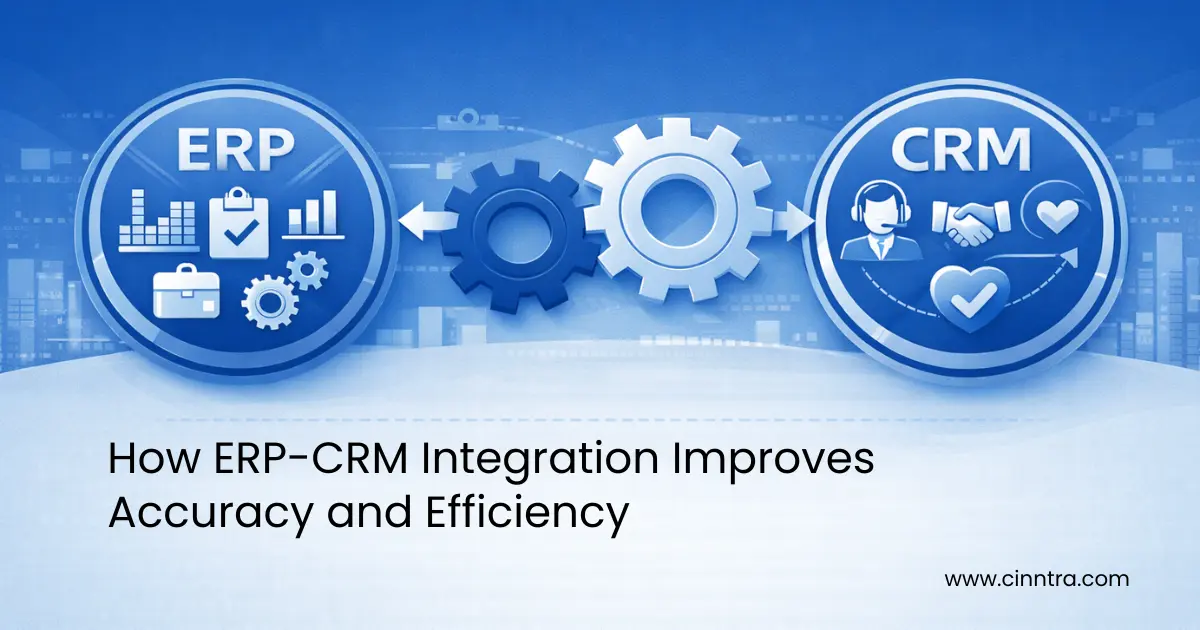
By 2026, the priciest problem inside most organizations isn’t inefficient, its misalignment masquerading as business as usual.
Sales charges ahead, sure of their numbers. Finance eyes every dollar with a raised eyebrow. Operations won’t commit until they’ve hedged every bet. Each team thinks they’ve got it right, but honestly, they’re all missing something.
Right, there is a space between what people believe and what’s true; data accuracy quietly falls apart. That’s also where slowdowns start to creep in. The whole point of ERP-CRM integration is to close this gap. Not by piling on more complexity, but by cutting out all the distortion.
The Reality Most Leaders Recognize but Rarely Name
Ask any executive why decisions always seem to drag, and you’ll get the usual chorus:
-
“Let’s double-check the numbers.”
-
“Run this by finance.”
-
“We need ops to sign off.”
These aren’t just processing headaches. They’re trust issues specifically, trust in the data itself.
When your systems can’t agree, everything slows down. People get nervous. Nobody wants to move fast because they’re not sure what’s real. After a while, all that waiting and second-guessing adds to missed chances.
The organizations that really stand out in 2026 fix this at the system level, not just by telling people to try harder.
What ERP-CRM Integration Actually Fixes (Beyond the Buzzwords)
On the ground, integration tackles three stubborn problems most companies wrestle with.
1. Data Fragmentation
Customer info, pricing, orders, and billing all end up in their own little bubbles. Integration forces them to live together. When something changes, it changes everywhere.
2. Temporal Lag
Disconnected systems mean information moves slowly. By the time you get the whole picture, you’ve missed your window. Integration keeps everything in sync as it happens.
3. Interpretive Work
Teams waste time translating or double-checking data. Integration makes these translations unnecessary. It sets up a single source of truth, so everyone sees the same numbers at the same time.
That’s when data accuracy stops being a wish and turns into the default.
Accuracy Is Not a Feature It Is a Byproduct of Design
Most companies chase accuracy with more checks, audits, and extra steps. It doesn’t scale. And when it fails, it fails quietly.
Integrated systems work differently.
When your platforms share their logic and data, mistakes stick out. Updates ripple through automatically. The rules stay the same everywhere. Errors show up fast, not weeks later.
Accuracy happens not because people are policing things harder, but because the system leaves less room for mistakes.
And that’s a big deal. It’s the line between a smooth operation and one that’s always putting out fires.
Operational Efficiency Starts Where Manual Work Ends
Everyone likes to talk about speed, but real efficiency starts with getting rid of manual work.
Every time someone must manually bridge the gap between ERP and CRM, that’s:
-
A delay
-
A new risk for mistakes
-
Extra mental load for employees
Automated ERP-CRM workflows wipe those bridges out. Systems talk to each other, actions trigger outcomes, orders move forward, and financials update, with no human in the middle.
You don’t just get faster work. You get cleaner work, with fewer steps and fewer places for things to go wrong.
Now, efficiency isn’t just a process; it’s baked into the way you operate.
The Unseen Advantage of Organizational Calm
With integrated systems, the energy in the workplace is completely transformed.
When data lines everywhere, uncertainty fades. People stop double-checking. Meetings aren’t spent reopening old debates. Decisions stop circling the drain.
This isn’t just about culture, it’s about architecture.
Organizations with real integration see fewer flare-ups, quicker agreements, and more confident choices. Not because everyone suddenly communicates better, but because the systems cut down on confusion.
That’s operational efficiency; nobody talks about enough.
What Modern Integration Looks Like in 2026
Modern ERP-CRM integration doesn’t look like it did years ago.
The new focus will be on:
-
Continuous real-time data synchronization instead of periodic data synchronization.
-
Integrating all systems using application programming interfaces (APIs) instead of point-to-point integrations, which are often fragile.
-
Using business rules that govern business processes rather than having an ad-hoc approach to completing business processes.
-
Building resiliency into all systems instead of assuming they will be resilient.
Building security and compliance into systems rather than tucking them into the final products. They’re woven into every move the data makes, so you stay protected without slowing down.
Best of all, good integration is ready for whatever’s next. It flexes and adapts without blowing everything up.
Visibility Without Micromanagement
Real visibility doesn’t mean data overloading. It means clarity, seeing how one thing actually affects another.
When ERP and CRM play nicely, you can see:
-
How promises turn into deliveries
-
How demand shapes your financial risk
-
How operational limits affect the bottom line
This kind of visibility doesn’t shackle teams; it frees them. People know what is happening and why. Leaders step in less because there are fewer surprises.
Visibility isn’t just a reporting chore. It’s a real advantage.
Integration Without Disruption Is the New Standard
People still think integration means tearing everything down and starting from scratch. Truth is that good integration keeps the lights on while you upgrade. You don’t rip out the old stuff. You build on it, step by step. As your systems get smarter, your oversight just gets tighter, no chaos, no drama.
Roll things out in phases. Test as you go. Make sure everyone knows who owns the data. That way, the transition doesn’t knock the wind out of your team. When you’re done, no one should even notice because nothing feels forced. That’s a sweet spot.
Why This Matters More Than Ever
With AI and automation moving faster than ever, everything comes down to data. If your information is a mess, mistakes multiply at a speed no human can keep up with.
Solid integration is the ground floor for any kind of smart tech. Miss that, and you’re stuck with patching problems by hand. But nail it, and you’re ahead of the curve faster, safer, and not chasing your own tail.
The Unbreakable Bond of ERP & CRM
ERP and CRM integration isn’t just about making systems talk. It’s about making sure your entire organization sees the same reality.
When your data is always accurate, and your workflows just work, you stop reacting and start steering. You get reliable results repeatedly. Confidence replaces constant fixing.
That’s where the right partner changes everything.
Cinntra doesn’t treat integration like some IT side projects. They treat it like architecture, thoughtful, deliberate, and built to last. They know every business has its quirks, and they respect them. By turning ERP and CRM into one unified system, Cinntra helps you move faster, stay in control, and keep your data trustworthy as you grow.
Business is only getting faster and messier. Coherence isn’t just nice to have; it’s what sets up the leaders apart from the ones always putting out fires.
In 2026, that’s what decides who’s calling the shots and who’s just trying to keep up.






0 Comments