Cloud vs Hosted vs On-Premises: Which ERP Ecosystem is Best for You
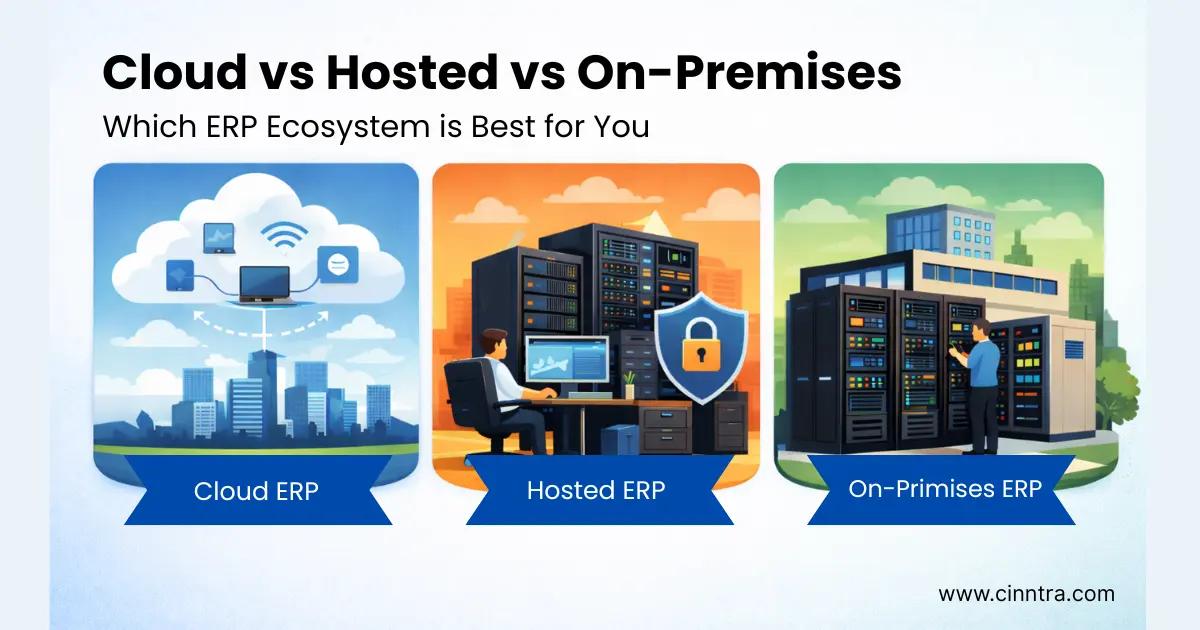
Selecting an ERP system requires more than just advancing technology. You must consider the day-to-day functionality of your business and how effectively it will operate after deployment.
When you explore ERP options, you usually research two primary categories: on-premises or cloud-based (or both). The debate surrounding the two breakdowns into two straightforward questions: How much control do you need? How quickly would you like to implement change?
Let's examine the basic choices available to assist you in making your selection.
Start With the Basics: Your 3 Options
There are three types of ERP solutions that fall into the category of ERP. Each of these three categories addresses the same issue; each solution approaches the problem in a different manner.
-
Cloud (SaaS) ERP
Cloud (or Software as a Service) ERP is the latest and most current commercial-grade ERP solution. Your ERP solution is provided on the vendor's servers, and your access to the solution is made using a web browser. You do not need to have an installed infrastructure; there is no need to perform manual updates, and there is little or no need for IT involvement aside from phone support.
Cloud (Saas) ERP is designed for speed and flexibility.
-
Hosted ERP
Hosted ERP is the next evolution of Cloud (SaaS) ERP. Your ERP solution will be hosted on a third-party server, and the user has greater control over the system than Cloud (SaaS) ERP however some shared responsibility for the configuration and maintenance of the system will be maintained by the host.
People often compare the cost of Hosted ERP to the cost of Cloud (SaaS) ERP, and as you can read labeled below, Hosted ERP is priced at a lower level than Cloud (SaaS) ERP, but with more cost responsibility to the user.
-
On-Premises ERP
On-premises ERP provides the user with full control. The entire ERP solution runs on your in-house / site servers, and you and your team/responsible personnel are responsible for the entire solution and the entire support solution (including any required hardware and software) in-house.
So, What’s the Real Difference?
Rather than making it more complicated, the distinctions between the various models will be made clear in practice, as follows:
-
Cloud ERP is faster than host ERP for implementation and the ability to scale without regard for infrastructure.
-
Hosted ERP offers flexibility but will still require hands-on administration.
-
On-premises ERP gives you control, but when you need to adapt, it can slow you down.
The essence of any comparison of on-premises ERP versus cloud ERP is speed versus control.
Let’s Talk About Cost (Because It Matters)
Every ERP decision will ultimately be driven by the budget.
In a cloud ERP model, expenses are dispersed over a period of time, so no significant upfront investment is needed, and expenses remain predictable.
In a hosted ERP model, the user will incur hosting costs while maintaining some degree of hands-on support and administration.
In an on-premises ERP model, the upfront investment is substantial. It may support long-term viability, but typically only if the organization’s needs remain constant.
Scaling Your Business Without Friction
Growing your business is fantastic unless your available resources and systems are unable to meet the demands generated by the growth.
Cloud ERP supports the natural progression of growth, adding users, expanding operations, and integrating with different applications; all done seamlessly.
Hosted ERP enables businesses to grow; however, it often requires prior coordination prior to making the changes.
On-Premises ERP can become a choke point when scaling. Scaling can involve significant investments in infrastructure that can take considerable time and effort to execute.
What About Security?
This is where many organizations hesitate.
The reason for this hesitation comes mainly from a lack of understanding as to how cloud service providers operate at scale. One of the outcomes of operating at scale is that they are able to invest in advanced security measures and ensure compliance. In many cases, they can provide a higher level of security and compliance standards than an organization can provide within their own internal organization.
You share the modern benefit of having a hosted ERP system with your service provider.
Although your on-premises ERP gives you complete authority, you also bear total responsibility for the results. You must rely on your company’s security processes and procedures for your data security and safety.
How Do You Actually Choose?
Stop focusing on the details of a software vendor’s features when determining which ERP solution works best for your organization.
-
If you are seeking to streamline and expedite your business, the cloud-based ERP is the right choice.
-
If you plan to convert your legacy systems into hosted systems, you should consider a hosted ERP solution.
-
If security, control, and customization are critical factors in your operations, you might consider staying with your on-premises ERP.
There is no ideal model; there is only the right model for your organization.
Planning the Move Matters More Than the Model
Making the right ERP decision is only part of the process. Ensuring the implementation of your ERP is done correctly is what will produce the end results.
The companies considering ERP solutions must concentrate on developing clear plans with well-defined processes for a structured transition, cleaning data, and completing system integration.
Companies that have implemented ERP migration services in Denver are moving away from their outdated legacy systems and transitioning into more adaptable environments.
On the other hand, organizations that are considering implementing ERP solutions in Houston, Texas want to build systems that will support business growth over the long term while avoiding the addition of business complexity.
Proper planning for your ERP implementation will help ensure your ERP solution is functioning correctly on the first day of use and not after several months of use.
Still Not Sure What Fits?
ERP solutions are not dictated by trends. They should lead to the simplification, speed, and sustainability of your business.
Cloud-based ERP solutions are the ultimate in flexibility, while the hosted ERP solution offers a balance between the two extremes of speed and flexibility. On-premises ERP solutions are great solutions for controlling and customizing your data.
Finally, the best decision relates to which ERP solution will reduce the friction of daily operational activities and improve operational efficiencies.






0 Comments