How SAP S/4HANA is Redefining Inventory Agility in the FMCG Sector?
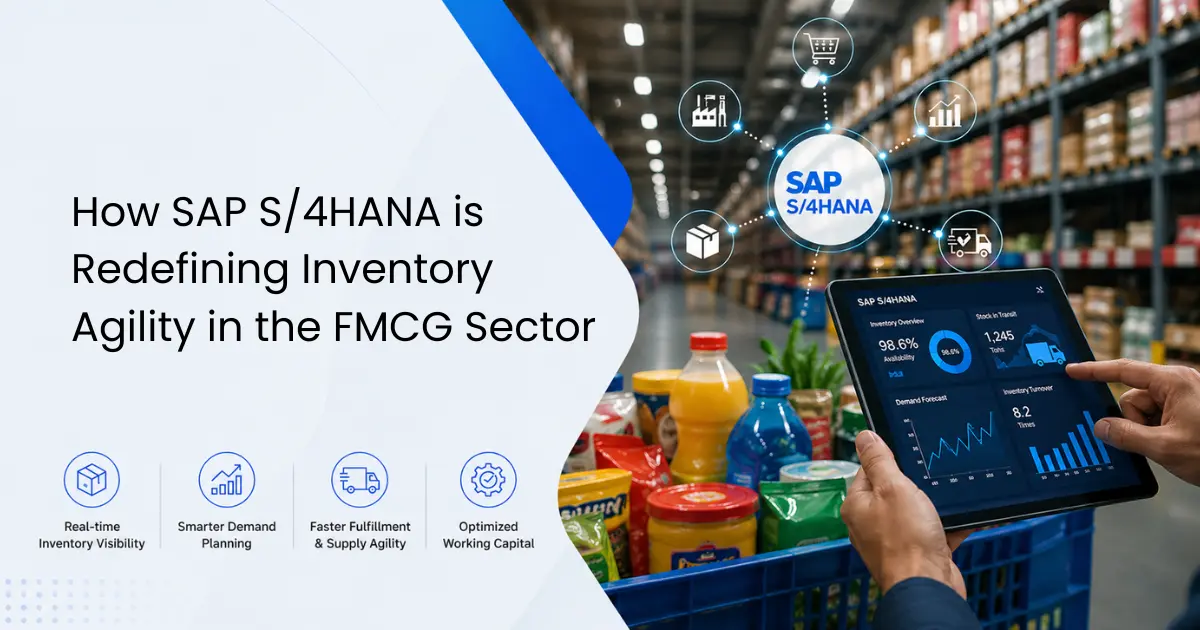
An item is taken off the shelf every second by a buyer. Behind that one transaction is a complex network of decisions regarding purchasing, manufacturing, and distribution. In today's highly competitive marketplace, there is no room for error – and when one link in the chain breaks, the brand loses revenue and trust. The question for FMCG companies is not if they are going to be modernized, but rather how quickly they can transform their operations.
That question is answered by SAP S/4HANA for FMCG. Manufacturing and Distribution companies now have real-time visibility and command to remain ahead of demand. The intelligent ERP in-memory solution replaces batch processing of legacy systems.
The Inventory Problem FMCG Companies Can No Longer Ignore
The FMCG industry has low margins and very short product life cycles. If you misjudge your inventory, you will put your company in a downward spiral. Overstocked product means your working capital is drained, and Undercutting Loyal Customers on the shelf because of not having enough stock will send them to competitors.
With Legacy Systems, this challenges the industry further because they process their data in batch mode nightly; when your decision is based on yesterday's data, it is impossible to make today's information.
In 2026, there are three dynamics making this overwhelmingly insufficient:
-
SKU proliferation: On average, more than tens of thousands of active products are being managed by any given FMCG company simultaneously on multiple channels.
-
Shelf-life pressure: Perishable goods call for precise rotation of inventory; each day over what your turnover should be becomes capital lost/vanished.
-
Demand volatility: Seasonal growth, promotional sales, and changing consumer behavior render existing forecasts invalid in weeks.
"The Cost of Poor Inventory Decisions for FMCG Companies is multiplied 1000s of times each day; Poor Inventory Decisions will not only cause one cataclysmic problem, but it is the accumulation of multiple small, easily avoidable errors, all occurring every day.”
What Makes SAP S/4HANA Different for FMCG Operations?
SAP S/4HANA is a major shift in how we think about business software, rather than simply another iteration of the same software. Built on the HANA in-memory database and able to process and surface data in real-time, SAP S/4HANA eliminates the latency so prevalent in the legacy solution and many other business applications today. For the FMCG space, SAP S/4HANA is a gamechanger.
By providing your organization with a single source of truth, SAP S/4HANA combines all aspects of your organization's operational processes, such as procurement, manufacturing, warehousing & finance, into one version of the truth. No longer do teams have to reconcile various & conflicting reports from multiple siloed systems; they can use SAP S/4HANA to leverage one true representation of their business in real-time.
The key areas of capability where organizations must leverage these core capabilities are:
-
Materials Management (MM) – Competitively automate procurement processes & hold suppliers accountable on an ongoing, real-time basis.
-
Extended Warehouse Management (EWM) – Natively embedding EWM provides real-time intelligent put away, first expired first out (FEFO) picking, and cross-dock task management across all distribution centers.
-
Sales & Distribution (SD) – The order capture process is now integrated with Available to Promise (ATP) checks, thereby closing the gap between the sales organization and the warehouse.
-
SAP Integrated Business Planning (IBP) – Uses machine learning from historic patterns, promotional calendars & market signals to create highly accurate forecasting under pressure.
Real-Time Inventory Management: From Reactive to Predictive
FMCG Inventory management requires fast inventory management, and SAP S/4HANA provides that in such a large way that it changes entirely how the business operation thinks about how to operate.
When shipping to a distribution center, SAP S/4HANA can update stock levels to the system, provide downstream replenishment signals (to get the products to the store's display), and calculate ATP across all open sales orders in a matter of milliseconds. No longer does a business manager have to wait until the next day to know that they do not have enough of a product available (they now get real-time alerts when a threshold has been reached).
Shelf-life management works the same way. The S/4HANA platform will force a first expired and first out (FEFO) method of operation at the picking level; direct the stock due to expire soonest to priority fulfillment channels; and indicate to the warehouse when to take action to purchase clearance costs for batches that are getting close to an unacceptable threshold, with no manual manipulation.
"Inwardly, SAP S/4HANA Inventory Management has resulted in reduced working capital by as much as 30% for manufacturers of fast-moving consumer goods, while concurrently achieving inventory accuracy levels of 99.5% through the use of In-Memory Processing."
Demand Planning That Keeps Pace with Consumer Behavior
FMCG 'Demand' Forecasting has traditionally been both a science and a subjective process. Integrating SAP IBP as a part of an S/4HANA system will tip the scales of demand forecasting from being predominantly subjective-based to a more science-based outcome.
By utilizing point-of-sale data, weather patterns, promotional schedules, and broader economic parameters as inputs, and then applying statistical-based and machine-learning-based algorithms, an S/4HANA environment will deliver demand forecasts that match the actual behavior of customers today, as opposed to six months ago.
Operational and commercial teams work collaboratively within a unified consensus-based planning system and eliminate the often blame-assigning behavior seen throughout the S&OP cycle, which is frequently a cause of diminishing levels of efficiency between operational and commercial functions.
What FMCG Companies Should Know Before Implementing?
Implementing an SAP ERP system is both strategic and complex; it cannot be simply moved over from the current system ("lift-and-shift"). The most effective ways to deploy an SAP ERP System follow a disciplined, phased approach to include: a detailed fit-gap analysis, structured build and configuration, thorough user acceptance testing, and hyper care after going live to ensure that operations stabilize.
Accelerators specifically designed for FMCGs (such as pre-configured templates for trade promotions, batch management, and regulatory compliance) can significantly reduce the timelines associated with deploying the SAP ERP system. With RISE with SAP, a company can also reduce the complexity of its infrastructure by moving to a fully managed cloud environment. This allows an organization's IT team to spend their time focusing on achieving business results rather than maintaining the SAP ERP Platform.
The most important factor in the success of an organization implementing an SAP ERP System is that change management teams that invest in user training, communication, and executive sponsorship consistently achieve much faster time-to-value and much greater adoption rates than other teams.






0 Comments